
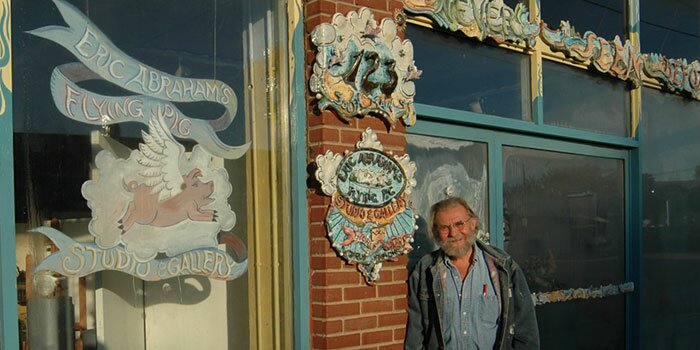
Eric Abraham lives in his own world.
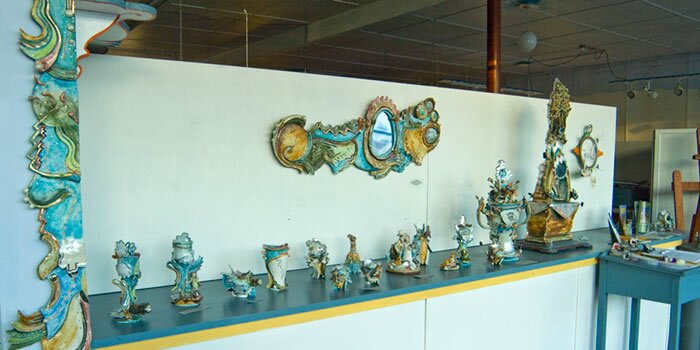
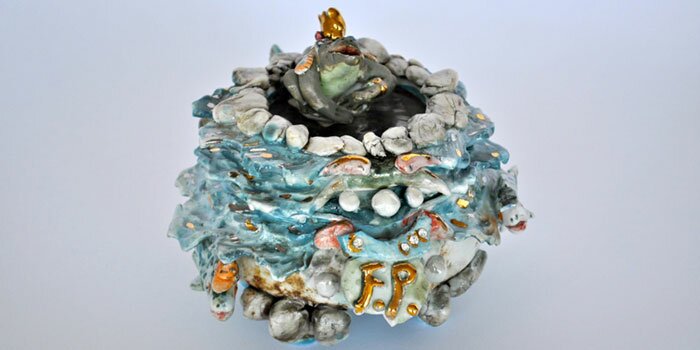
Abraham's ceramic sculptures are easily identifiable
pieces of that world that serve as small gateways into his imagination.
Sometimes they are melodramatic mirrors with bright colors, adorned
with ornaments and animals. Sometimes they are intricately detailed
fire-breathing dragons. Sometimes they are flying animals with
funny hats.
But hardly any of it is straight out of reality.
"They're not too serious. They're fun,
and I try to keep it a little tongue-in-cheek," Abraham,
of Waubansee, Kan., said. "It's not something you see every
five minutes."
Abraham isn't the type of person you
see every five minutes either.
At roughly 5 and a half feet tall, with bright
eyes, strong forearms and a bushy gray beard holding bits of the
ceramic dust that covers his jeans, Abraham resembles a dwarf
of Tolkien's creation, toiling away at his kiln. Other than a
17-year stay in Denver, Colorado, Abraham said he has never lived
in one place for more than five years. He also claims to have
seen a flying saucer, though he doesn't have an explanation for
the phenomenon, and he has driven around the country in a 1950
Chevrolet school bus that has sometimes served as his home.
Abraham collects things, too. The loft of
the schoolhouse he converted into his home holds numerous old
radios dating from the 1930s to the '60s. In a back room of his
studio are his National Geographic magazines -- he has nearly
every issue from 1908 to the present -- and he also has an assortment
of old cameras and soda bottles that lie around with the rest
of the clutter with which Abraham surrounds himself.
Such characteristics make it easy to mistakenly
label Abraham as an outsider artist. Though Abraham is an outsider
art enthusiast, he is too aware and educated to truly fall into
that category, said Jay Nelson, co-owner of the Strecker-Nelson
Art Gallery.
"Nobody in the country is doing what
he's doing with porcelain," he said. "It's a combination
of what appears to be naive or outsider art with really good technical
skills. So even though it looks somewhat naive, he has the skills
and education to understand what he's doing."
Abraham received his bachelor of fine arts
from the Kansas City Art Institute, and his Master of Fine Arts
from the University of Nebraska.
He taught for two years at K-State before
leaving under circumstances he says some people "may still
be sore about." He worked at Hallmark Cards in Kansas City,
Mo., in the mid 1960s, and he has been working in porcelain since
1985.
Abraham's art is witty and eccentric, while
appealing to a young sense of humor, Nelson said. He pointed out
a cup titled "There Have Been Allegations Made, and This
is the Alligator," that prominently features an alligator
as one example of the humor with which Abraham endows his art.
"His pieces are full of little
jokes like that," Nelson said.
Nelson said the Strecker-Nelson has been showing
Abraham's work for about 20 years now. When the gallery moved
a year ago, Nelson said, one room was designed, from color to
structure to lighting, specifically to display Abraham's work.
Of course, some people are apprehensive to
pay for pieces that prominently feature flying pigs with hats.
Abraham said people sometimes need authorities in art to tell
them it is OK to buy the eccentric work.
As for the hats, Abraham said, it wasn't his
idea.
"The pigs started wearing hats, and all
the other animals decided they wanted hats, too," he said.
"You know how children are -- 'Well, the pigs have hats,
so I've gotta have a hat, too. I want one with a feather.' 'I
want one with a propeller.'
"That's why they have hats. It wasn't
my doing. They tell me what kind of hats they want."
Abraham said he became interested in art when
he was a child, drawing pictures for the stories he liked since
many of the illustrations were inadequate. That child-like approach
still influences Abraham's work. He talked about his adoration
of Will Rogers, Mark Twain and British author Arthur Ransome's
books about children going off on adventures while avoiding their
parents.
Abraham even illustrated "Peaceful Poems:
Poems for Bedtime," a limited-press book of poems on display
at the Strecker-Nelson.
"I've done a lot of things with fairy-tale
themes, but I think they're just as much for adults' rooms,"
he said. "They're not primarily for children, and if it's
for a child, it has to be a child that's not going to take it
out and smash it."
In actuality, the structures of those pieces
are especially influenced by Baroque and Rococo sculpture, Abraham
said. The two eras were known for the exploration of the artists
in realism and elegant, decorative beauty.
Nelson said Abraham struggled to be accepted
in the art world, and now, with other artists and professors buying
his work, that has been achieved. But his struggle for acceptance
hasn't watered-down Abraham's style.
"Eric is an intellectual, an eccentric,
and very independent, which is probably why he doesn't teach,"
Nelson said. "Teachers are expected to teach certain things
a certain way, and he likes to go his own way." So Abraham
works in his own way in a gutted double-wide trailer converted
into a studio next to his house. Surrounded by half-finished projects
and characters he has brought into existence, Abraham said he
sometimes feels 5 years old when he's making art.
That's why it's no surprise Abraham values
his active imagination.
"Art is but a permanent figment of the
imagination," he said. |